Green
Forecast conditions are within the configured advisory parameters for the selected operation. Normal planning controls still apply.
Daily trade planning for site managers
A normal weather app tells you it will rain. Construction Weather tells you whether that rain — or wind, heat, cold or gust — stops the operation you have planned. Green, Amber and Red risk grading across more than 20 construction trade activities, with hourly detail and practical mitigation guidance.
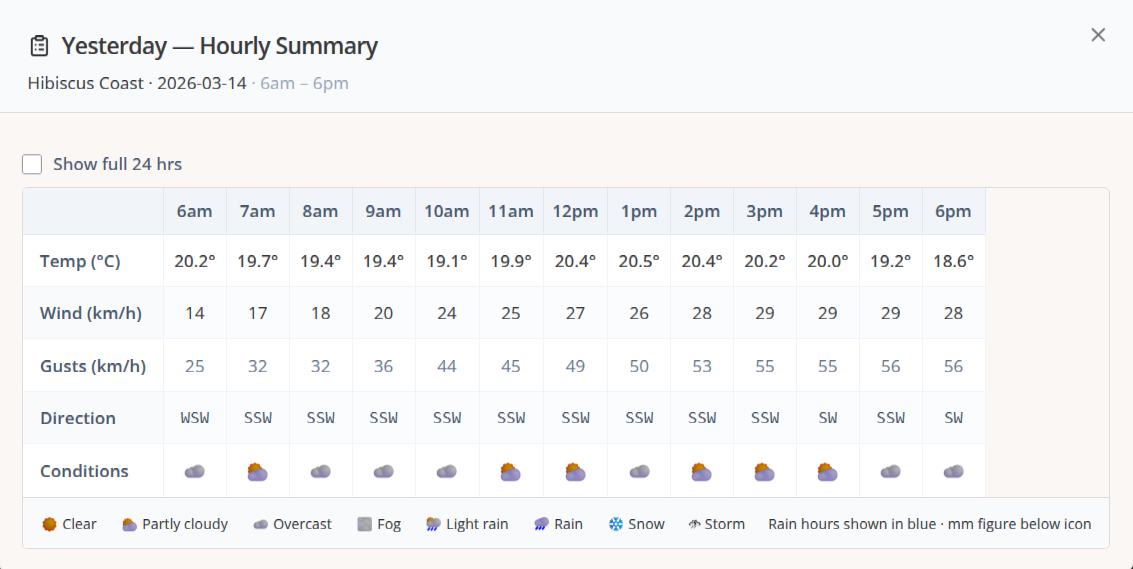
Every morning, site managers face the same decision: can this operation run today? Construction Weather answers that question with operation-specific data rather than a generic forecast. Select a trade and review a daily Green, Amber or Red advisory. Flagged days can be examined at hourly resolution so teams can plan the timing of work and consider mitigation measures before committing crew and plant.
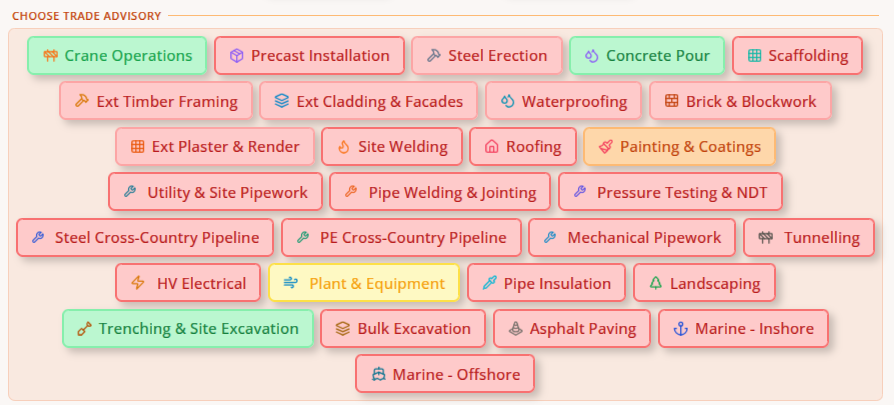
Forecast conditions are within the configured advisory parameters for the selected operation. Normal planning controls still apply.
Conditions may constrain the operation. Review timing, method, supervision and mitigation before proceeding.
Conditions exceed a configured advisory threshold. Examine the hourly forecast and the project's safety and operational requirements.
Every project has different operational limits. The notifications section lets you configure project-specific alert thresholds — wind speed, rainfall intensity, temperature, humidity — so alerts reflect your method statement or specification, not generic defaults.
Set your thresholds →Advisories are decision-support information. Site-specific risk assessment, manufacturer instructions, approved methods, competent-person judgement and applicable regulations remain controlling.
Weather affects different trades very differently. Each advisory is matched to the specific parameters relevant to the selected operation — not a generic forecast.
Wind speed and gusts — graded against manufacturer-specified limits for the crane type and configuration.
Wind and gust conditions relevant to erection and alteration of tube, system and special scaffolding.
Wind, gusts and rain — covering both crane-assisted placement and slip risk on structural steel sections.
Rainfall intensity, temperature (min/max), wind and humidity — covering placement, finishing and curing.
Wind speed, humidity, dew point and temperature — key parameters for WPS compliance under API 1104, ASME, AWS D1.1 and similar codes.
Humidity, dew point spread, temperature, rainfall and wind — covering the application window for industrial and protective coatings.
Humidity and dew point — critical for achieving and maintaining blast-cleaned surfaces before coating application.
Rain, wind and temperature — covering membrane installation, lap sealing and adhesive application conditions.
Wind and rain — covering panel handling and installation conditions for facade systems.
Rain, frost and temperature — covering mortar setting conditions and protection requirements.
Rainfall intensity and frost — covering trafficability, compaction and slope stability conditions.
Ambient and substrate temperature, rainfall and wind — covering placement and compaction window conditions.
Rain, frost, temperature and wind — covering application, drying and curing conditions for external plaster systems.
Rainfall and wind — covering trafficability for plant movement and wind sensitivity for tall rig configurations.
Wind and gusts — covering suction-lift handling limits and sealant application conditions.
Rain, humidity and wind — covering moisture exposure risk and handling conditions for structural timber and roof trusses.
Site-level spatial context
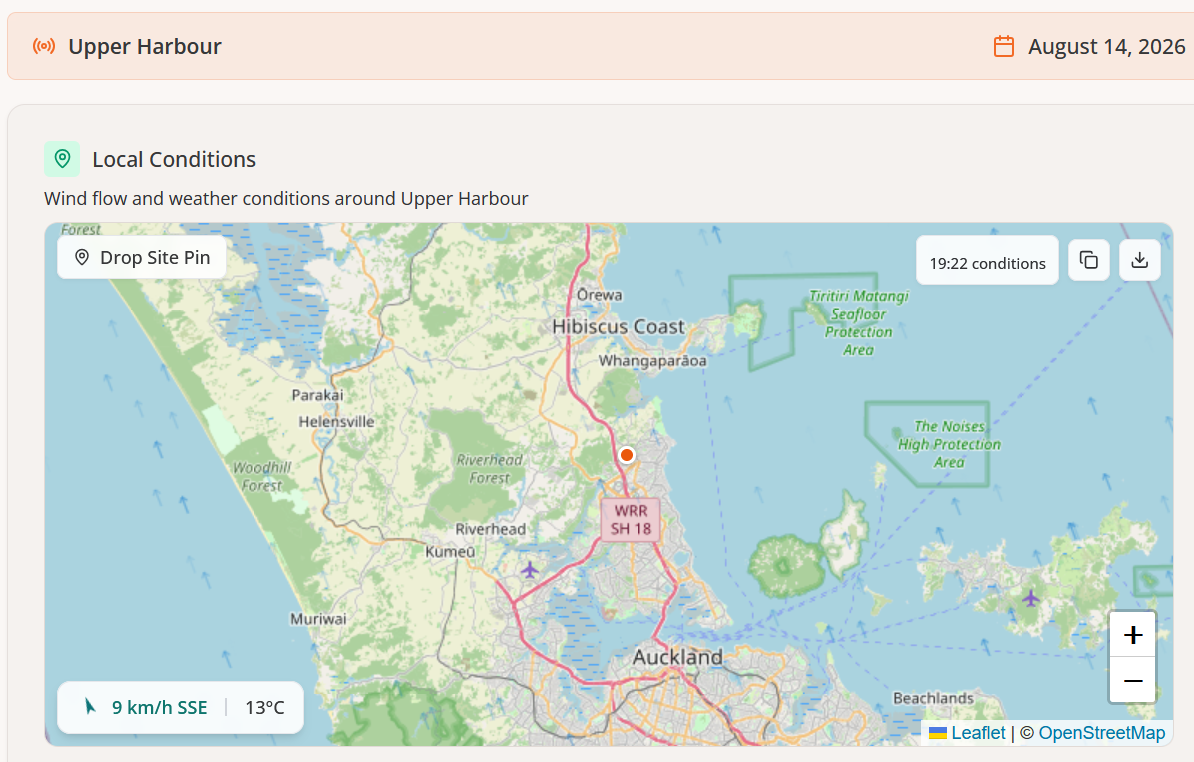
The Local Conditions map shows animated wind-flow across the area surrounding your pinned site location. Where a forecast gives you a wind speed figure, the map shows you the direction, spatial variation and terrain influence shaping conditions on the ground. That context helps teams judge whether a gusting southerly is funnelling through a local gap or whether conditions across the site are broadly consistent.
Historical context
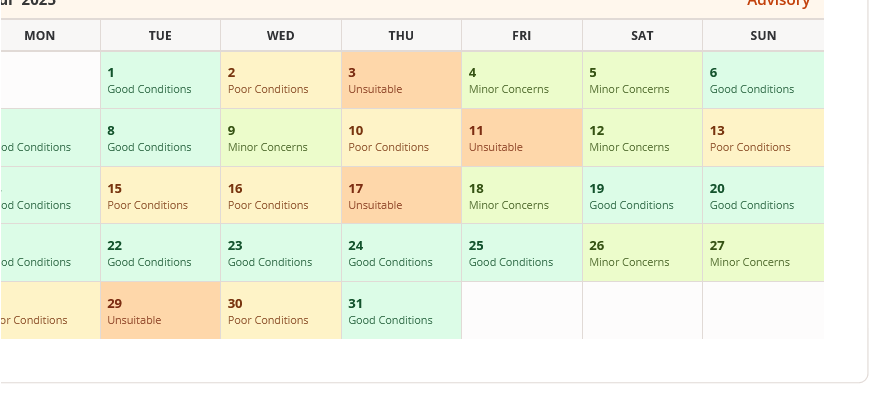
Where historical records are available for the selected location, the platform can show how forecast conditions compare with the five- and ten-year average for that time of year — helping teams assess whether conditions are unusually severe or broadly expected.
Historical data →Construction Weather covers the full project weather cycle — from tender through to extension-of-time evidence.
Turn forecast risks into editable early-warning notice drafts for project-team review before conditions arrive.
Benchmark a project month against historical data and identify potential qualifying weather events for extension-of-time review.
Use ten years of historical data to estimate average unsuitable days by operation and project month at the proposed location.
Retrieve dated weather records for any project location and export them for reports, delay reviews and project records.
Common Questions
The advisories feature covers more than 20 construction trade operations, including crane and lifting, scaffold erection, steel erection, concrete placement, structural and pipeline welding, painting and applied coatings, blasting and surface preparation, roofing and waterproofing, cladding and curtain walling, masonry and brickwork, earthworks and excavation, road surfacing and asphalt, external render and plastering, piling, glazing and facade installation, and timber framing and joinery. Each operation is matched to the weather parameters relevant to that trade.
Green means forecast conditions are within the configured advisory parameters for the selected operation — normal planning controls still apply. Amber means conditions may constrain the operation; teams should review timing, method, supervision and mitigation before proceeding. Red means conditions exceed a configured advisory threshold; teams should examine the hourly forecast and the project's safety and operational requirements before committing crew and plant. Advisories are decision-support information; site-specific risk assessment and competent-person judgement remain controlling.
Yes. The notifications section of the platform allows you to configure project-specific alert thresholds for wind speed, rainfall intensity, temperature, humidity and dew point. This means alerts can reflect your crane manufacturer's limits, welding procedure specification, coating product data sheet or contract method statement rather than generic defaults.
The trade advisory forecast covers 14 days ahead. The first three days are generally reliable. Days 8–14 are indicative and should not be relied upon for precise operational decisions — they are useful for advance programme planning and early awareness of potentially significant conditions. A separate Forecast Lookahead feature extends the outlook further for tender planning and programme purposes.
No. A general weather forecast tells you it will rain. A Construction Weather advisory tells you whether that rain — or wind, frost, heat, humidity or gust — stops the specific operation you have planned. Each advisory is matched to the parameters relevant to a selected trade, not to a generic weather description. The platform applies the same threshold logic used in construction contract adverse weather clauses, making it relevant for site planning and contractual record-keeping rather than general weather awareness.
Explore construction-focused forecasts, historical records and reporting tools for your next project location.